Garage Door Damage 101: Repair, Replace, or HOA Rules?
Bumped your garage door and not sure if you need a repair, full replacement, or HOA approval? Here’s how we help homeowners sort out damage, safety, and rules.
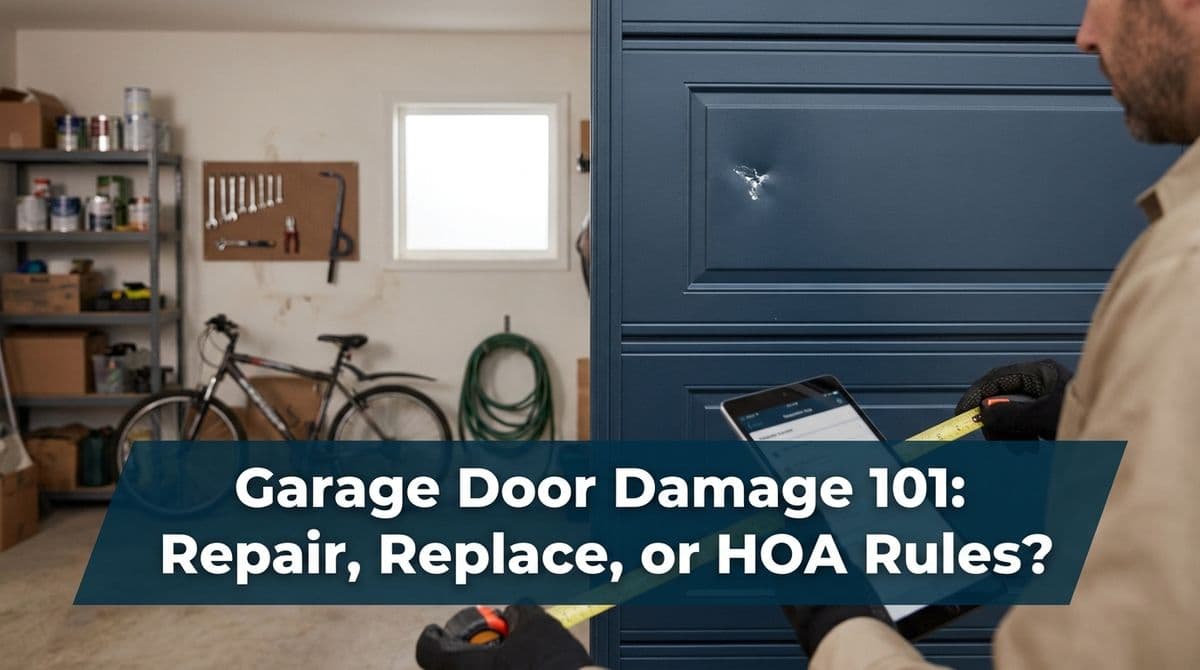
The “Little Bump” Call That Turned Into a Bigger Question
We recently got a call from a customer — let’s call him Mark — who started the conversation the same way a lot of people do:
“I bumped the garage door with my car a while ago. It still works fine, but there’s this little bulge and crack that’s slowly getting worse… do I really need to replace the whole thing?”
On top of that, Mark lives in a townhouse community with a homeowners association (HOA). The HOA president had just been walking the neighborhood, pointing out doors that might need paint or replacement, and hinting that changes might need to match across multiple units.
So Mark wasn’t just asking, “Is my door okay?” He was really asking, “Do I repair this small ding, replace the whole door, and how does my HOA factor into that decision?” Here’s how we walked him through it — and how we’d walk you through it, too.
When a Small Ding Is Truly “No Big Deal”
When we come out to look at a “little bump,” we’re really checking two things: safety and structure. If both are sound, you may be able to hold off on full replacement.
In situations like Mark’s, we start with a quick visual checklist you can actually do yourself before we arrive:
- Panels: Is the panel just slightly bent, with no sharp edges, tears, or big creases? Is the metal or composite still mostly flat around the damage?
- Tracks: Do the tracks look straight, firmly attached, and not pulled away from the wall?
- Operation: Does the door open and close smoothly without jerking, popping, or grinding?
- Gaps and light: With the door closed, do you see any new gaps where daylight or drafts are sneaking in around the damaged area?
If everything looks and feels normal, we might recommend:
- Panel-level repair or replacement instead of a full door
- Minor cosmetic work (e.g., straightening a small bend, touch-up painting)
- Monitoring the area if the damage is very light and not spreading
We always explain our findings on-site so you understand whether your “ding” is just ugly or actually unsafe.
Signs Your “Little” Damage Is Becoming a Big Problem
In Mark’s case, he mentioned something important: the crack and bulge were “slowly getting worse.” That’s a red flag we never ignore, because small impacts can weaken the structure of the door over time.
Here are signs we use to help customers decide when repair isn’t enough and replacement should be on the table:
- Creases across an entire section: If a panel has a big crease from side to side, it’s usually lost much of its strength.
- Cracked or torn metal/composite: A crack that’s growing or splitting is a structural failure, not just cosmetic damage.
- Door goes crooked or out of alignment: If the door looks tilted or doesn’t meet the ground evenly anymore, the frame or panels may be compromised.
- Strain on the opener: If your opener sounds louder, labored, or keeps reversing unexpectedly, it could be fighting a damaged or binding door.
- Repeated band-aid fixes: If you’re calling for the same area over and over, you’re usually throwing money at a door that’s on its way out.
When we spot these issues during an inspection, we’ll show you exactly where the problems are and explain whether a replacement will actually be cheaper and safer in the long run than piecemeal repairs.
How HOAs Complicate (and Sometimes Simplify) the Decision
Because Mark lives in a townhouse community, the HOA’s rules had to be part of the conversation. We deal with HOAs frequently, and we’ve learned that every community is a little different, but there are some common themes.
Common HOA Requirements We See
When we coordinate with HOAs, we often run into rules like:
- Uniform appearance: All garage doors must match in style, color, and sometimes even brand or model.
- Pre-approved colors and designs: Only certain colors, panel designs, or window layouts are allowed.
- Approval before replacement: Homeowners may need written approval before changing a door, even if it’s damaged.
- Shared costs: For townhomes or condos, the HOA may pay part (or all) of the cost if the door is considered a “common element.”
With Mark, we offered to speak directly with the HOA contact, review any guidelines, and propose options that would keep his door compliant. We take the same approach with any HOA community we work in.
Who Pays: You, the HOA, or Insurance?
Another question Mark had — and one we hear a lot — is, “Will the HOA cover this, or am I on the hook?” While every community is different, here’s how we help homeowners sort it out:
1. Check Your HOA Documents
We always recommend pulling out your HOA bylaws or CC&Rs and checking:
- Is the garage door listed as a unit responsibility or a common element?
- Does the HOA cover maintenance only or also damage from accidents?
- Are there any cost-sharing provisions (for example, HOA pays for the standard door, you pay to upgrade)?
Once you know what the paperwork says, we can tailor our quote and options to match what’s likely to be approved.
2. Consider Your Homeowner’s Insurance
We’re not insurance adjusters, but we do remind homeowners that some accidental impacts — like backing into your own door — may be covered under your homeowner’s policy, depending on your deductible and coverage. When a door needs full replacement, we can provide detailed estimates and photos you can share with your insurer or HOA.
How We Typically Help in Situations Like Mark’s
When someone like Mark calls us about a “small” ding that might not be so small, here’s the process we usually follow:
- On-site inspection: We measure the door, check the tracks, springs, and opener, and closely inspect the damaged area.
- Safety and structural assessment: We explain whether the damage is strictly cosmetic or if it’s affecting the door’s integrity and your opener’s workload.
- Repair vs. replace options: We lay out panel repair/replacement and full-door replacement options with clear pricing.
- HOA coordination: With your permission, we’ll talk to your HOA president or manager, share brochures and color samples, and help them pick compliant options.
- Upgrade conversations: If you’re replacing anyway, we walk you through insulation levels, window options, and design choices that could boost curb appeal and comfort.
Our goal is to take the stress and guesswork out of the decision so you’re not staring at a growing crack wondering if today’s the day it finally fails.
Not Sure If Your Garage Door Ding Is Serious? Start With a Visit.
If you’ve bumped your garage door and it “still works,” but something about it doesn’t look right, we always recommend getting a professional set of eyes on it. Whether you’re in an HOA community like Mark or in a single-family home with no restrictions, we’ll walk you through:
- Whether the damage is cosmetic or structural
- What’s safe to live with for now and what’s not
- Repair vs. replacement costs and options
- How to keep your door compliant with HOA or neighborhood standards
A “little ding” can stay little — or it can turn into a headache. We’re here to help you make the right call before it does.