DIY vs. Professional Garage Door Opener Repairs
Handy with tools? Learn which garage door opener repairs are safe to DIY, and when it’s smarter and safer to call a professional for help.
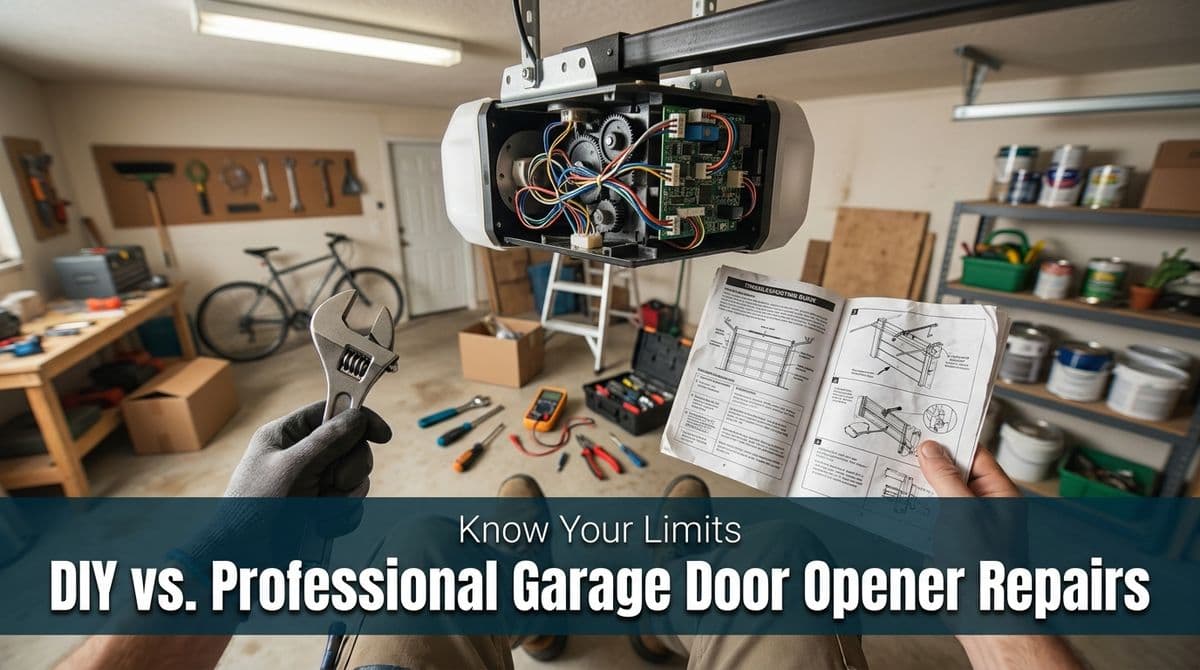
DIY vs. Pro Garage Door Opener Repairs: A Real Call Story
We recently got a call from a homeowner — let's call him Tom — who described himself as being "in the DIY business." Tom had an older LiftMaster half-horsepower opener, and the receiving eye (one of the safety sensors) had gone out. He wanted to know one thing: could we just sell him the part so he could fix it himself?
Tom isn’t alone. A lot of handy homeowners call us asking, “Can I just replace this part myself, or do I really need a technician to come out?” In Tom’s case, we offered to stop by for a free estimate to confirm the sensor was actually the problem and that nothing else was wrong with the motor.
Using Tom’s situation as a springboard, we’ll walk through when it makes sense to tackle garage door opener repairs yourself — and when it’s safer, cheaper, and less stressful to call a pro.
Understanding the "Receiving Eye" and Safety Sensors
When Tom called, he told us his “receiving eye” was bad. What he was talking about are the photo eye safety sensors that sit near the bottom of the garage door tracks on each side.
These sensors do two important things:
- Send an invisible beam across the door opening
- Stop and reverse the door if something breaks that beam (child, pet, object)
On most setups, one side is the sending eye and the other is the receiving eye. If either fails, your door may refuse to close, or only close when you hold the wall button down.
Common DIY-Friendly Sensor Problems
We often find that what looks like a “bad sensor” is actually something simple you can safely check yourself before buying parts:
- Misalignment: The sensors must be aimed directly at each other. If one gets bumped, the opener will think something is in the way.
- Dirty lenses: Cobwebs, dust, or road grime on the lens can block the beam.
- Loose brackets or hardware: A sagging bracket can cause intermittent problems.
- Cut or loose low-voltage wires: Sometimes the problem is in the wiring, not the sensor itself.
Those are exactly the kinds of things we like to rule out during a quick visit, so you don’t spend money on a part you don’t actually need.
Garage Door Opener Repairs You Can Usually DIY
Tom wanted to buy and install the part himself, and we told him what we tell most handy homeowners: some opener repairs are very DIY-friendly, as long as you’re comfortable with basic tools and follow safety steps.
Typically Safe & DIY-Suitable Tasks
- Adjusting or cleaning safety sensors
Gently clean the lenses, straighten the brackets, and make sure both sensor lights are solid (not blinking). - Replacing sensor brackets or sensor eyes
If we’ve confirmed the sensor is bad, swapping it out is usually straightforward: disconnect power, match wires by color or terminal, mount the new sensors, and align. - Programming remotes or keypads
Most manuals or manufacturer websites walk you through this step-by-step. - Replacing simple accessories
Wall buttons, light bulbs (rated for opener use), and battery backups can usually be replaced safely.
DIY Safety Tips for These Jobs
- Disconnect power first: Unplug the opener before touching any wiring.
- Use a sturdy ladder: Never stand on boxes or makeshift steps.
- Follow the manual: Look up your exact model number so you’re using the right instructions and parts.
Repairs That Should Be Left to a Professional
When we offered Tom a free visit, it wasn’t because we didn’t trust his DIY skills — it was because the line between “simple sensor issue” and “bigger, potentially dangerous problem” can be thin.
Here are some situations where we strongly recommend bringing in a pro.
Anything Involving Springs or Major Door Components
Your opener is only part of the system. If the door itself isn’t balanced correctly, the opener will struggle, and parts will fail faster. We do not recommend DIY on:
- Torsion or extension spring replacement
- Major cable repairs
- Track realignment after impact
These components are under significant tension. A wrong move can cause serious injury or property damage.
Internal Opener Repairs and Motor Issues
On Tom’s call, we also mentioned that we like to check “nothing else is wrong with the motor.” That’s because if:
- The opener hums but doesn’t move
- It smells like something burned
- Gears are stripped or the circuit board is damaged
…then replacing a sensor won’t solve the real problem. Motor and circuit board work is usually better handled by someone with the right tools and training. In many cases, if the opener is older, it makes more sense to replace the unit rather than sink money into electronics.
Why We Offer a Free On-Site Estimate First
When Tom asked if we could just sell him the part, we said yes — but we still recommended sending a technician out within the hour for a free estimate to double-check:
- That the sensor was truly the failed component
- That the model number and part number matched
- That there weren’t hidden issues with the motor or door
From our side, this quick visit saves homeowners from a common headache: buying the wrong part, installing it, and then discovering something else is actually broken. From your side, it lets you decide — with good information — whether you still want to DIY the repair or have us handle it.
How to Decide: DIY or Call a Pro?
When you’re staring at a stubborn opener, ask yourself these questions:
- Is the problem clearly with an accessory or sensor, not the motor or springs?
- Do you feel confident working on a ladder and around low-voltage wiring?
- Is your opener relatively modern with parts still readily available?
- Are you okay if your DIY attempt doesn’t fix it the first time?
If you’re unsure, we’ll do what we did for Tom: come out, take a close look at your system, confirm the diagnosis, and then let you choose whether to buy the part and handle it yourself or have us do the repair. Either way, you end up with a safer, more reliable garage door — and fewer surprises.